

Every year, as a new financial cycle approaches, organisations repeat a familiar ritual. Targets are reset. Budgets reworked. Plans refreshed.
Teams talk about doing better—improving performance, reducing waste, growing faster, staying ahead. There’s optimism in fresh spreadsheets and clean forecasts. We tell ourselves that this year we’ll stay on top of things, control expenses, run operations smoothly, and avoid last‑minute chaos.
But experience teaches us something else: progress rarely comes from planning alone. It comes from the decisions made after the planning ends.
Every day, teams make small operational choices: Approve now or revisit later? Patch quickly or test thoroughly? Fix today or let next week’s version of ourselves handle it? None of these feels dramatic in the moment. But over time, these ordinary decisions quietly shape outcomes.
Consider a simple example. A company delays renewing its automated backup subscription. Systems are running fine, so the team decides it can wait. A little time saved. A little money saved. Weeks pass without incident.
Then an employee accidentally deletes a shared folder with contracts, invoices, and operational records. No one panics—at first. IT is expected to restore everything. Only then does the team discover the last reliable backup was taken weeks earlier. Operations slow down. Documents are recreated. Clients are contacted. Deadlines slip. The money saved was small; the disruption was not.
The problem wasn’t the deletion. It was the missing safety net.
We can’t eliminate every mistake. And that’s exactly what risk management is about.
Rethinking Risk
Part of the confusion comes from how we interpret the word risk. It often evokes danger, loss, or failure. But risk is simply uncertainty—and uncertainty exists in every meaningful decision.
ISO 31000 defines risk as: “The effect of uncertainty on objectives.”
Notice what’s missing? Fear.
Risk isn’t the enemy. Without it, there’s no innovation, entrepreneurship, or growth. The real danger is pretending risk doesn’t exist.
And that illusion is harder to maintain today. Modern organisations operate in deeply interconnected, unpredictable systems. A cloud outage can halt operations across continents. A regulatory change can reshape an industry overnight. A data breach can erase years of trust in hours.
Uncertainty isn’t an occasional disruption anymore. It’s part of the operating environment.
And it turns into real problems far more often than leaders assume.
- IBM reports that 83% of organisations have experienced more than one data breach.
- The World Economic Forum ranks cyber incidents among the top global business risks.
- The National Cyber Security Alliance says 60% of small businesses shut down within six months of a major cyberattack.
These aren’t rare events. They’re the environment we operate in.
A Simple Mental Model
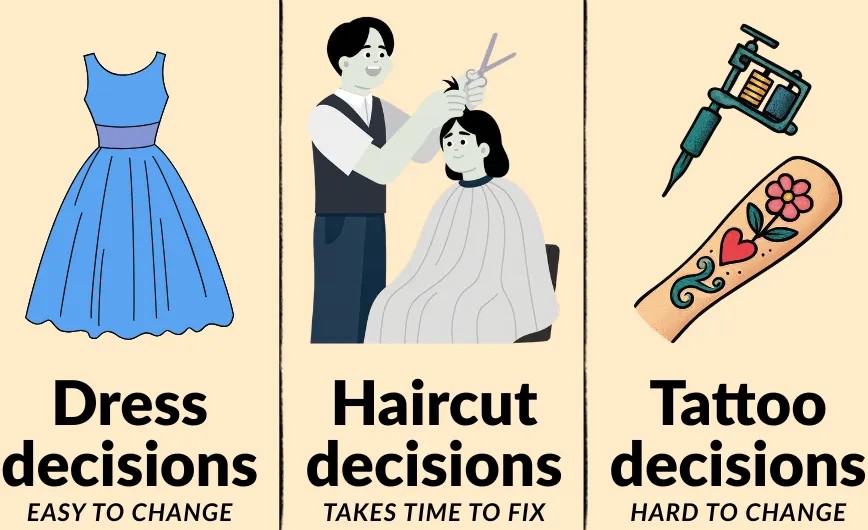
Not all decisions deserve the same level of attention. A useful analogy: some decisions are like a dress, some like a haircut, and some like a tattoo.
A dress is reversible. If it doesn’t work, you return it. In business, these are experiments—trying a new marketing channel, testing a workflow, trialling a tool. Low cost of being wrong. High learning value. Move fast.
A haircut is recoverable, but uncomfortable. Hiring a contractor, launching a pilot, switching tools. Mistakes grow out eventually.
A tattoo is different. Removing it is expensive and painful. In business, these are decisions about core technology, long‑term vendor agreements, entering new markets, or regulatory commitments. Hard to undo. High‑impact. Slow down.
Speed for dresses. Caution for tattoos.
Where Risk Management Helps
This analogy highlights the core idea: not every risk needs the same level of scrutiny. Some decisions should be quick. Others require deeper analysis.
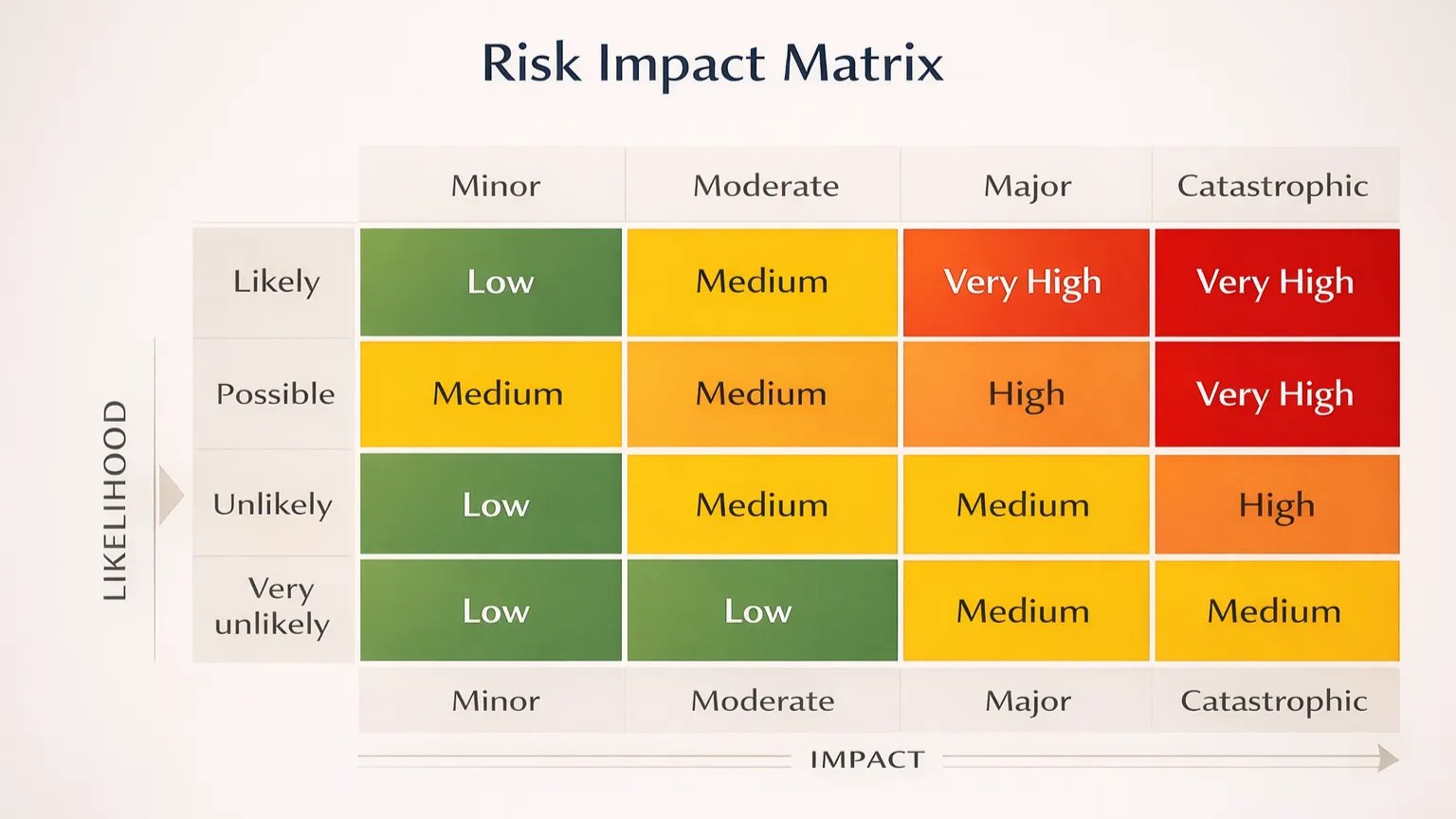
Risk management begins with a few practical questions:
- What could go wrong?
- Where are the single points of failure?
- How likely is this?
- What would the impact be?
- What small step could reduce the risk?
The answers don’t need to be perfect. They just need to exist.
Risks rarely live in one place. They hide in conversations, half‑finished documents, Excel trackers, and the assumption that “someone else is handling it.” Over time, they fade from attention. What began as a known issue becomes the problem everyone remembers noticing but no one remembers owning.
This is where simple risk systems matter. Instead of disappearing into hallway conversations or meeting notes, risks can be recorded, assessed, assigned, and tracked. Abstract concerns become observable events. And observable events can be managed.
A Small Shift, A Big Difference
Revisit the earlier backup example. In a risk‑aware environment, someone might have logged a simple risk: data loss due to insufficient backup coverage. The impact would be clear. A mitigation action assigned. Even if the organisation still delayed the solution, the risk would remain visible—not lost in a meeting no one remembers.
That visibility changes behaviour. Risks stop being abstract. They become operational realities.
Ironically, many traditional risk systems failed because they were too heavy—lengthy documentation, rigid frameworks, compliance workflows so complex that teams avoided them unless forced.
Modern tools, like Risk Assurance Platform (RAP), focus on visibility, ownership, and action. Quick logging. Lightweight scoring. Clear owners. Simple mitigation steps.
Designing for Uncertainty
Risk management isn’t about preventing every failure. That level of control doesn’t exist. Mistakes will happen. Systems will break. Markets will shift.
What risk management does is ensure those inevitable surprises don’t become existential threats.
The difference between resilient and fragile organisations rarely comes down to intelligence or ambition. It often comes down to whether someone paused before an ordinary decision and asked:
“What happens if this goes wrong?”
Written by Bidisha Nag
Beyond Gut Decisions: Why Modern Risk Management Is a Strategic Necessity
Every year, as a new financial cycle approaches, organisations repeat a familiar ritual. Targets are reset. Budgets reworked. Plans refreshed....
 April 30, 2026
 ![[Whitepaper] Proactive Enterprise Risk Management](https://www.riskassuranceplatform.co.uk/wp-content/uploads/2026/02/risk-management.jpg)
[Whitepaper] Proactive Enterprise Risk Management
Organisations globally face an increasingly complex risk landscape, yet many continue to rely on outdated, inefficient methods for risk management....
February 3, 2026 
Analyse Risk with Power BI
We are pleased to announce the general availability of our Power BI content pack for the Risk Assurance Platform. This...
 April 2, 2024